


Nasdaq Picks Kraken. Solana Passes Ethereum. Morpho Passes Aave
Nasdaq picks Kraken. Morpho beats Aave on Base. Solana passes Ethereum in RWAs. The rails are being laid while everyone watches the price chart.
1/ Nasdaq + Kraken partnership
[TOKENIZATION]
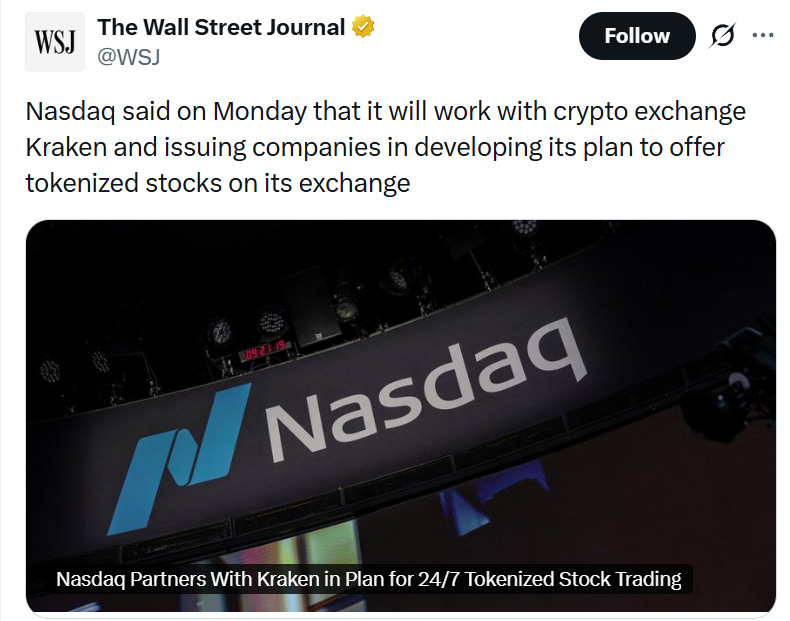
WSJ just reported that Nasdaq is building an equity token design with Kraken's xStocks as the permissionless layer on top. The model gives token holders full shareholder rights, voting, dividends, 24/7 trading, rather than just price exposure. xStocks already has $25B in transaction volume, 85K holders, and $4B settled on-chain. KYC and AML compliance runs through Kraken's Payward Services. The launch target is H1 2027, pending regulatory approval. This follows ICE taking a board seat at OKX the week before, which we just discussed in the Byblos weekly digest, both of the major US exchange operators now have active bets on crypto-native distribution for equities.
Why it matters: The two biggest US exchange operators now compete to tokenize their products.
2/ Solana hits 163K RWA holders
[RWA]
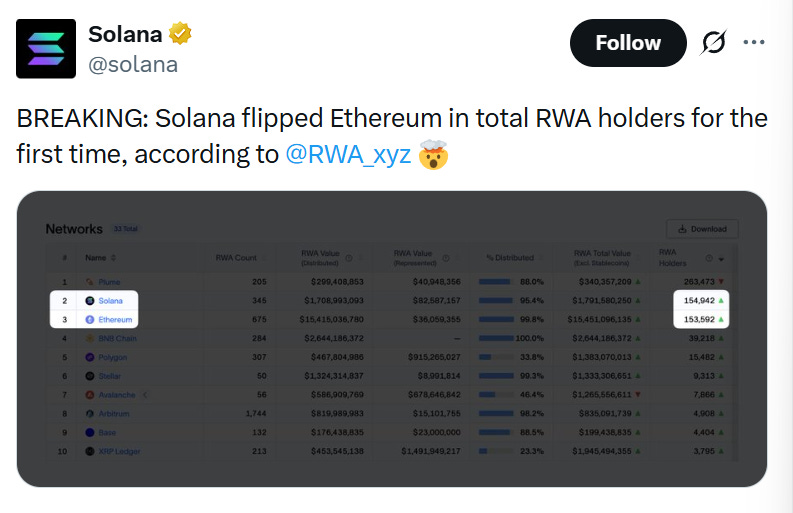
Solana now hosts 163,000 RWA holders as of March 9, a record high and more than Ethereum for the first time. The sector has grown 289% year-over-year to $25B total value. Most of the growth is in private credit and on-chain treasury bills, driven by institutional demand rather than retail. Solana getting here ahead of Ethereum has less to do with protocol fundamentals and more to do with UX, cheaper transactions and a simpler onboarding path for non-crypto-native institutions.
Why it matters: In RWAs, holder count beats TVL as a distribution signal.
3/ Morpho Takes #1 on Base, Now on 29 Chains vs Aave's 19
[DEFI]
Morpho is now the largest lending market on Base with $1B borrowed, ahead of Aave's $539M on the same chain. Across all networks, Morpho operates on 29 chains versus Aave's 19, and grew loans outstanding from $1.9B to $3B in the past year. The gap has widened partly because Morpho moved into markets Aave was slower to serve, Base being the clearest example. Aave is still larger overall and has the brand, but Morpho has been consistently faster to deploy in new ecosystems and the numbers are showing it.
Why it matters: Aave wins on TVL, Morpho wins on speed, and Base is the most visible proof point.
4/ Stable Summit IV — Cannes, March 27–28
[EVENTS]
Stable Summit returns to Cannes for the fourth edition, right before EthCC. The event runs March 27–28 and covers the full stablecoin stack, from regulated issuers and central banks to permissionless DeFi protocols. It started in 2022 when nobody was paying attention to stablecoins institutionally, and now it lands in a cycle where the GENIUS Act is in active negotiation, stablecoin supply is at $310B, and Standard Chartered is warning of $500B in bank deposit drains. The timing makes it the most relevant edition yet.
Why it matters: Important stablecoin policy and infrastructure conversations of Q2.

5/ Armstrong: Crypto Will Break Down Barriers in Capital Formation
[INFRASTRUCTURE]
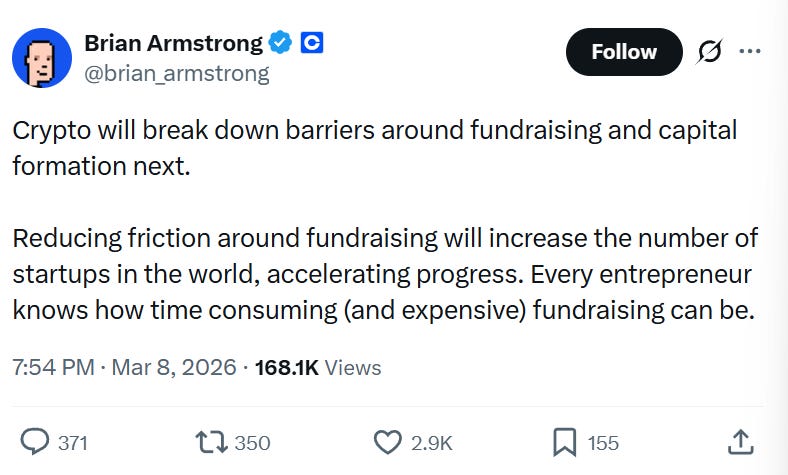
Brian Armstrong posted on March 8 that the next major impact of crypto will be in fundraising and capital formation, reducing how long and expensive it is to raise money for a startup. He said on CNBC the same week that nearly $100T in capital and credit markets could eventually be rebuilt on blockchain. This is consistent with Coinbase's 2026 roadmap, which includes tokenized equities, stablecoins for settlement, and Base as a distribution layer. Armstrong has been laying this out publicly for months, the capital formation comment is the clearest signal yet of where Coinbase is pointing its product roadmap.
Why it matters: Coinbase becomes a infrastructure for startup fundraising.
6/ EF PhD Fellowship — Deadline April 1
[GRANTS]
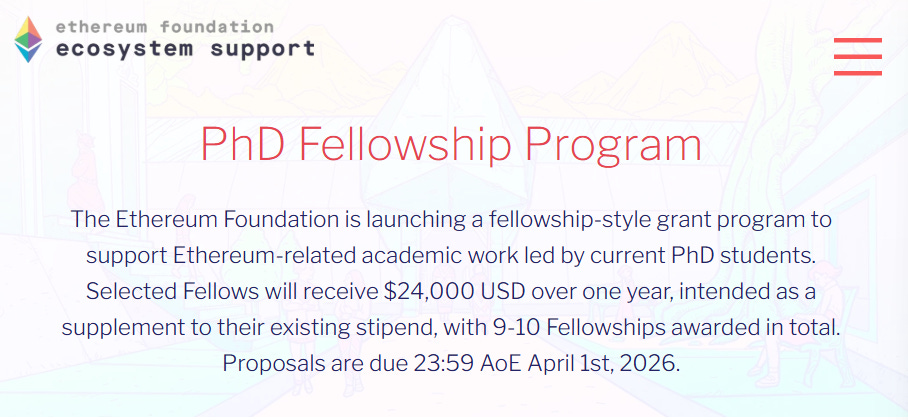
The Ethereum Foundation opened a new PhD Fellowship Program on February 2 and closes applications April 1, three weeks from now. It awards $24K per fellow as a stipend supplement, with 9–10 fellowships total. Topics span cryptography, consensus design, economics, formal verification, and P2P networking. The research output has to be open-access. It's not a large check but it's EF-backed, which carries weight for academic positioning inside the ecosystem.
Why it matters: If you are a PhD researcher working on Ethereum-adjacent problems, this is worth it.
That’s the week. Now go build something.
— Byblos.digital